A walk-behind seeder is a mechanical planting machine designed to sow seeds in rows while the operator pushes it forward. Unlike broadcast seeding, which spreads seeds over a wide area, a walk-behind seeder places seeds at controlled intervals and depths.
A typical push seeder combines a seed hopper, ground wheel, seed metering mechanism, furrow opener, seed tube, covering device, and press wheel. These components work together to open the soil, release seeds, cover them, and prepare the seedbed for germination.
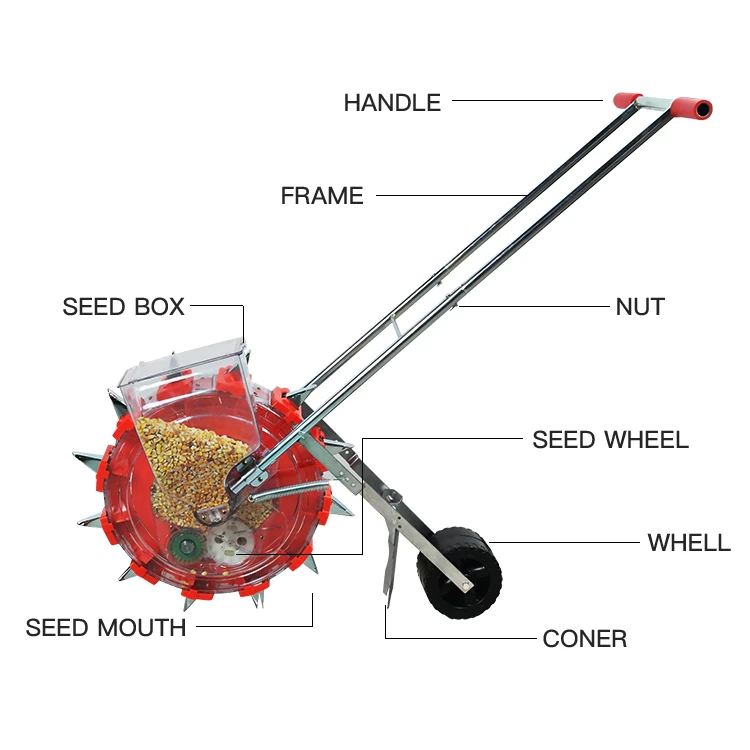
The working principle is based on a simple mechanical process: the forward movement of the machine rotates the ground wheel, and the ground wheel drives the seed metering system.
How Does a Walk-Behind Seeder Work?
The working process of a walk-behind seeder can be divided into 5 main steps:
| Step | Main Function |
| 1. Seed Filling | Stores and supplies seeds to the metering system. |
| 2. Ground Wheel Drives the Metering System | Transfers mechanical motion to the seed metering system. |
| 3. Seed Metering and Dropping | Controls seed quantity and spacing. |
| 4. Furrow Opening and Seed Placement | Controls planting depth and places seeds in rows. |
| 5. Soil Covering and Pressing | Covers the seeds and improves seed-to-soil contact. |
1 Seed Filling
Before operation, the operator fills the seed hopper with clean and properly prepared seeds.
The seed hopper stores the seeds and supplies them to the metering mechanism. Depending on the machine design, the seeder may use a seed plate, roller, rotor, or another type of metering device.
The correct metering system should match the size and shape of the seeds. Large, small, round, and irregularly shaped seeds may require different metering components to achieve consistent planting.
Before starting, the operator should also check:
- Seed hopper capacity
- Seed size and shape
- Seed metering adjustment
- Row spacing
- Planting depth
- Seed quantity required per row
These settings help the hand push seeder achieve more consistent seed placement.
2 The Ground Wheel Drives the Metering System
The most important part of the working principle is the connection between the ground wheel and the seed metering mechanism.
When the operator pushes the machine forward, the ground wheel rolls along the soil and begins to rotate. This rotary motion is transferred through an axle, shaft, gear, chain, or another drive structure to the seed metering system.
The basic mechanical process is:
Forward movement → Ground wheel rotation → Shaft or transmission system → Seed metering mechanism
The ground wheel therefore does more than support the machine. It also provides the mechanical movement needed to operate the metering system.
Because the metering mechanism is connected to the ground wheel, seed release is related to the distance traveled by the push seeder. This allows seeds to be released at regular intervals instead of falling continuously from the hopper.
The exact transmission structure may vary between models. Some machines use gears, while others use chains, shafts, or other mechanical connections.
3 The Metering Mechanism Measures and Drops the Seeds
After the ground wheel drives the metering system, the metering mechanism picks up and releases seeds one by one or in a controlled quantity.
A typical seed metering system may include:
- A rotating seed plate with individual cells
- A roller with seed grooves
- A vertical rotor
- A scraper or seed-cleaning device
- A seed outlet or drop tube
As the metering component rotates, seeds enter its cells or grooves. The mechanism then carries the seeds to the release point. Excess seeds may be removed by a scraper or similar device so that the system can maintain more consistent seed spacing.
After release, the seeds move through the seed tube and fall toward the furrow.
The seed spacing depends on several factors, including:
- Ground wheel rotation
- Transmission ratio
- Seed plate or roller design
- Metering adjustment
- Operator walking speed
- Seed size and shape
The metering mechanism is therefore the main component responsible for controlling the planting rate and distance between seeds.
4 The Furrow Opener Creates the Furrow and Places the Seeds
While the metering system prepares the seeds, the furrow opener creates a narrow groove in the soil.
The furrow opener may be designed as a blade, shoe, tine, or similar soil-engaging component. Its main functions are to:
- Open the soil
- Maintain the required planting depth
- Create a suitable space for the seeds
- Guide the seeds into the soil
The seed tube directs the released seeds into the furrow. In this way, the walk behind seeder places seeds in a prepared row instead of scattering them across the soil surface.
Planting depth is important because seeds planted too deeply may have difficulty emerging, while seeds planted too shallowly may dry out or become exposed. The suitable depth depends on the crop, seed size, and soil condition.
Some push seeders allow the operator to adjust the furrow opener or depth-control component to meet different planting requirements.
5 The Machine Covers and Presses the Soil
After the seeds enter the furrow, the covering device moves soil back over them.
The covering system may use a chain, blade, disc, or another soil-covering component. Its purpose is to close the furrow and protect the seeds from direct exposure.
A press wheel then lightly firms the soil above the seeds. This helps improve seed-to-soil contact and creates a more stable seedbed.
Hand Push Seeder Working Video
Conclusion
A walk-behind seeder uses a simple mechanical system to control seed spacing, planting depth, and row placement, making it suitable for efficient row planting with less manual work.
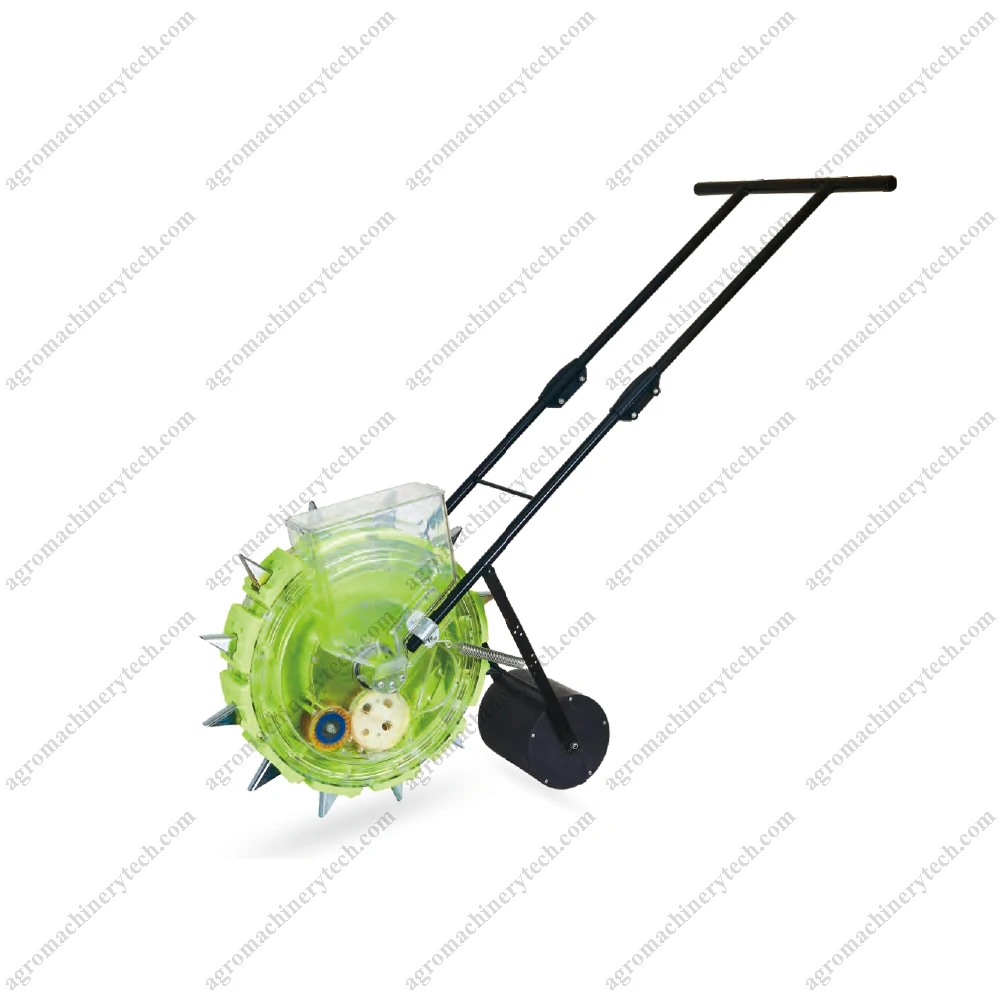
A036 hand push seeder
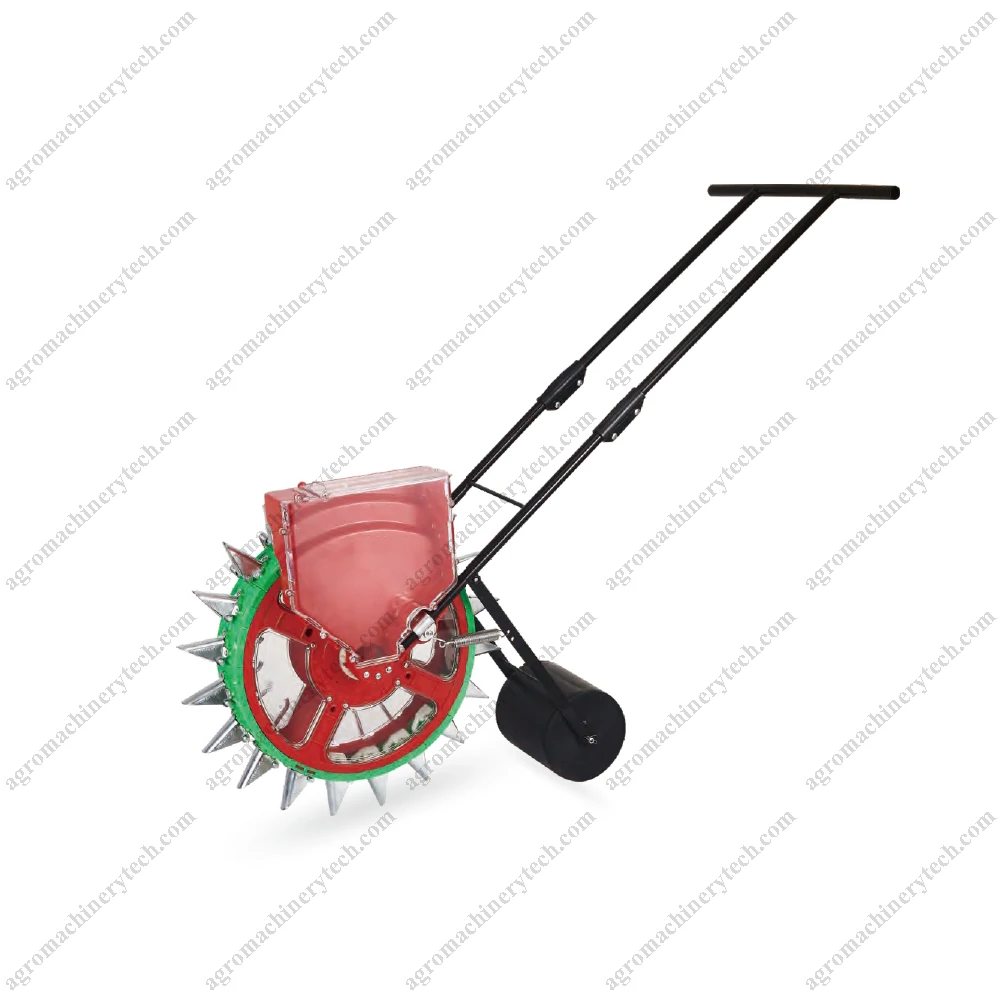
A038 hand push seeder
For different planting requirements, AgroMachineryTech offer 4 hand push seeder models with different numbers of seed outlets (mouths). The number of mouths determines how many rows can be planted in one pass, allowing buyers to select a suitable configuration according to crop type, field size, and planting requirements.
| Model | Mouth Number | Adjustable Spacing |
| A031 | 5–8 mouths | 31 / 25 / 21 / 18.5 cm |
| A032 | 5–10 mouths | 31 / 25 / 21 / 18.5 / 17 / 15 cm |
| A036 | 6–12 mouths | 25 / 21 / 18.5 / 16.5 / 14.5 / 13 cm |
| A038 | 10–20 mouths | 16 / 14 / 12 / 10.5 / 9 / 8 cm |
If you are a distributor, agricultural machinery dealer, farm, or project buyer, we can provide the appropriate hand push seeder model for your market and application. Contact us with your required number of mouths and quantity, and we can recommend a suitable model and provide a quotation.