Choosing the right power tiller is one of the most important decisions for any farmer. Whether you own a small family farm or provide land preparation services, the right machine can improve productivity, reduce labor costs, and handle multiple farming tasks with ease.
Today’s market offers a wide range of hand tractor models. However, differences in engine type, transmission, chassis design, attachments, and spare parts availability can significantly affect long-term performance and operating costs.
This guide explains the 7 most important factors to consider before purchasing a chinese walking tractor, helping you choose the model that best fits your farming needs.

Looking For The Best Power Tiller Price ?
Get durable power tillers at almost 2/3 of the power tiller price from Agromachinerytech.
7 Considerations Before Buying a Power Tiller from China
| Consideration | Why It Matters |
| Engine Power | Determines the tractor's working capacity and efficiency. |
| Engine Type | Affects fuel consumption, torque, and operating costs. |
| Transmission & Travel Speeds | Improves control, maneuverability, and working efficiency. |
| Implements & Attachments | Expands the tractor's functionality beyond tillage. |
| Spare Parts Availability | Reduces maintenance costs and downtime. |
| GN or DF Chassis | Different chassis designs affect compatibility and future maintenance. |
| Manufacturer & Supplier | Ensures long-term product quality and after-sales support. |
1. Choose the Right Engine Power
The first thing most buyers look at is horsepower (HP). However, bigger isn’t always better. The ideal engine power depends on your farm size, soil conditions, and the type of work you plan to do.
As a general guideline:
| Engine Power | Recommended Applications |
| 8–10 HP | Vegetable gardens, light cultivation, small farms |
| 12 HP | General farming, rotary tillage, transportation |
| 15 HP | Rice fields, medium-sized farms, multiple implements |
| 18–22 HP | Heavy-duty tillage, commercial farming, transport work |
Remember that choosing excessive horsepower may increase fuel consumption and purchase costs without providing additional benefits.
2. Decide Between a Diesel or Gasoline Engine
Another important decision is whether to buy a gasoline or diesel power tiller.
In most agricultural applications, diesel engines are preferred because they offer:
- Higher torque for heavy tillage
- Better fuel economy during long working hours
- Longer service life
- Lower operating costs over time
Gasoline engines are generally lighter, quieter, and easier to start, making them suitable for homeowners or light-duty agricultural work.
For professional farming and commercial land preparation, a diesel power tiller is usually the better investment.
Learn More: Diesel vs. Gasoline Power Tillers – Which One Is Right for Your Farm?
3. Check the Transmission and Travel Speeds
Many buyers focus only on engine power but overlook the transmission system.
A quality walking tractor should provide enough gear options for different farming operations.
Most commercial power tillers are equipped with:
- 6 Forward Gears
- 2 Reverse Gears
Lower gears provide greater pulling force for plowing, rotary tillage, and working in muddy fields. Higher gears improve transport efficiency when hauling trailers or moving between fields.
Travel speed is equally important. Different manufacturers may offer different forward and reverse speeds even if the number of gears is the same. A wider speed range gives operators better control when using different implements or working under varying field conditions.
A reliable transmission also makes turning, reversing, and operating attachments much easier.
4. Consider Compatible Implements and Attachments
One of the biggest advantages of a power tiller is its versatility.
Instead of performing only one task, a hand tractor can become a multi-purpose farming machine simply by changing attachments.
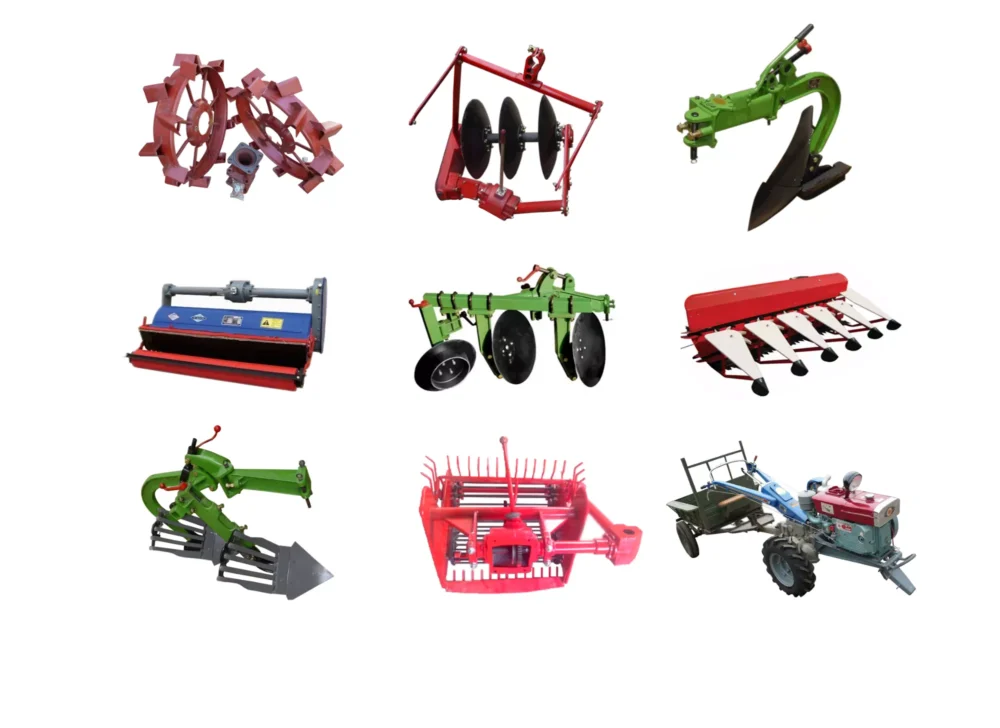
Common power tiller attachments include:
- Rotary tiller
- Moldboard plow
- Disc plow
- Ridger
- Trailer
- Seeder
- Water pump
- Sprayer
- Reaper
For most farmers, the rotary tiller is the standard attachment included with the machine. However, if you plan to transport crops, make ridges, or irrigate fields, make sure your hand tractor implements are compatible with the tractor before purchasing.
Buying a machine that supports multiple implements allows you to expand its capabilities without investing in additional equipment.
5. Make Sure Spare Parts Are Easy to Find
Even the best power tiller requires routine maintenance.
Before placing an order, always confirm whether power tiller spare parts are readily available in your country.

Frequently replaced parts include:
- Tires
- Rotary blades
- Belts
- Bearings
- Clutch components
- Gearbox parts
- Oil seals
Easy access to replacement parts reduces downtime and keeps your machine working throughout the farming season.
For export markets, choosing a supplier with a stable spare parts inventory is often more important than selecting the cheapest machine.
Learn More: How to choose correctly your power tiller tyre?
6. Choose the Right Chassis Type: GN or DF
If you’re sourcing a China power tiller, you’ve probably heard about the two most common chassis platforms: GN and DF.
These are not different engine sizes—they are different tractor platforms with unique chassis and transmission designs.
GN (Sifang)

A Sifang power tiller (GN type) is generally built with a heavier chassis and is well suited for demanding agricultural work. Many farmers prefer GN models for heavy-duty tillage and long working hours.
DF (Dongfeng)
A Dongfeng power tiller, also known as a DF power tiller, features a different chassis structure and is widely used across Africa and Southeast Asia. It offers reliable performance while maintaining excellent value.

Although both platforms may use the same horsepower engine, many structural components—including gearbox parts, clutch assemblies, wheel hubs, and transmission components—are not interchangeable.
If your local market already has many GN machines in operation, purchasing another GN model makes future maintenance much easier. The same principle applies to DF models.
When buying a China hand tractor, always confirm whether you need a GN or DF chassis before placing your order.
7. Choose a Reliable Manufacturer and Supplier
Finally, don’t choose a power tiller based on price alone.
A reliable manufacturer can provide much more than the machine itself, including:
- Stable product quality
- OEM & ODM services
- Spare parts supply
- Technical support
- Export experience
- Professional packaging
- After-sales service
If you’re importing from China, selecting an experienced China power tiller manufacturer can reduce risks and ensure long-term support for your business.
At Agro Machinery Tech, we specialize in manufacturing and exporting walking tractors and agricultural machinery for customers worldwide. Our product range includes both Sifang power tiller (GN) and Dongfeng power tiller (DF) series from 12 HP to 22 HP, with a full selection of compatible implements and spare parts to meet different farming requirements.
With over 35 years of experience in power tiller manufacturing, we understand the needs of farmers and distributors in different markets. Our manufacturing facilities operate under an ISO 9001-certified quality management system, ensuring every machine meets strict quality standards before delivery.
To give our customers greater confidence, we also provide a 12-month warranty and comprehensive after-sales support. Whether you need technical assistance, spare parts, or OEM & ODM services, our experienced team is ready to help you build a reliable and long-lasting farming solution. Contact us now!
Buy Our
Chinese Power Tiller Now!
Get durable power tillers at almost 2/3 of the power tiller price from Agromachinerytech.
Conclusion
The best power tiller isn’t simply the one with the highest horsepower or the lowest price. Instead, it’s the machine that matches your farming requirements, supports the implements you need, offers reliable spare parts, and comes from a trustworthy manufacturer.
Before making your purchase, evaluate these seven key factors:
- Choose the right engine power.
- Decide between diesel and gasoline.
- Compare transmission and travel speeds.
- Check implement compatibility.
- Confirm spare parts availability.
- Select the appropriate GN or DF chassis.
- Work with a reliable manufacturer.
By taking these factors into account, you’ll invest in a walking tractor that delivers reliable performance, lower operating costs, and greater productivity for years to come.